Founding cohort·$150 → $120 for the first cohort.·Full price after that.
Building AI Agents: From Models to Production
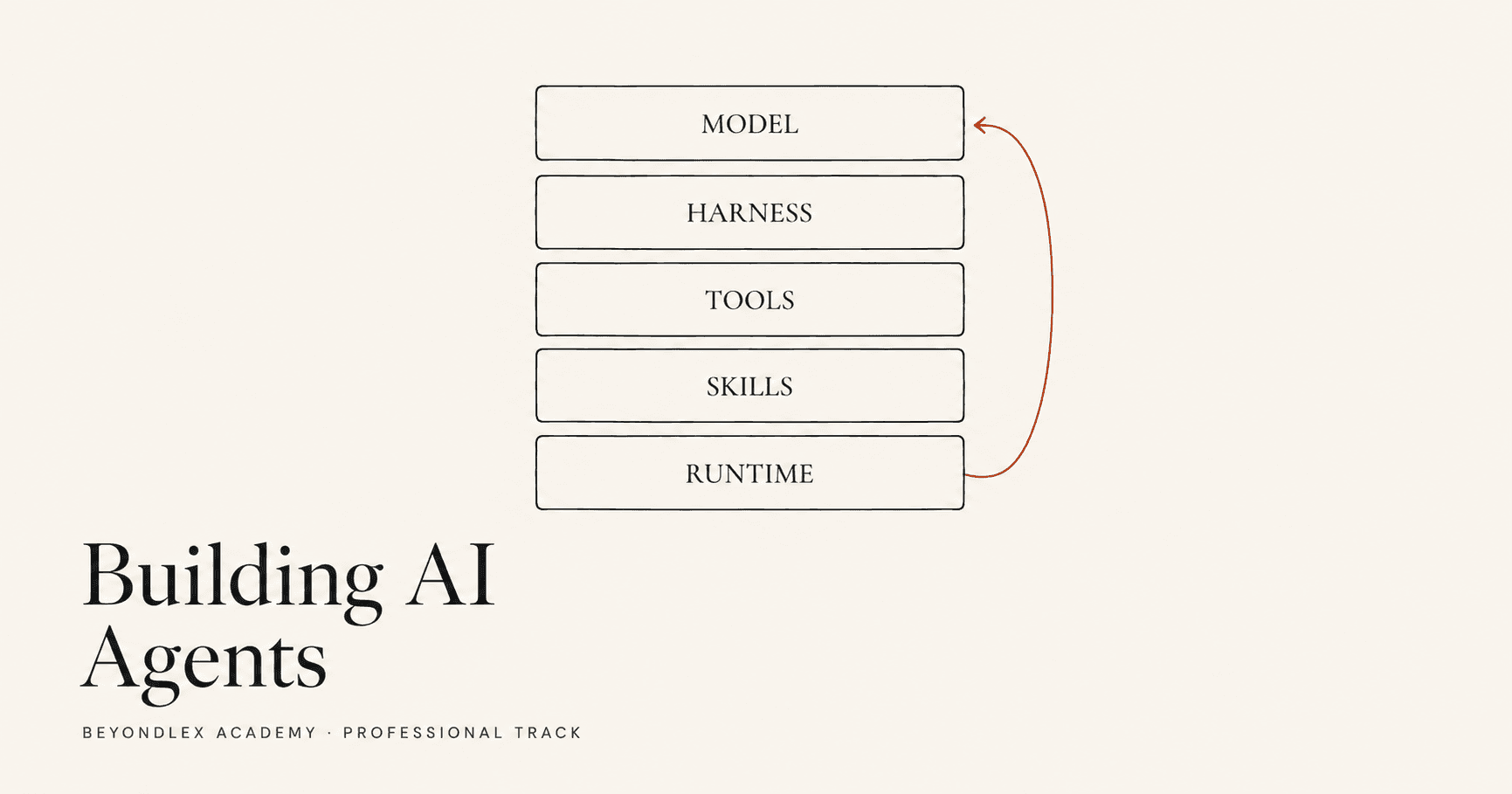
Go deep on agents — build a production agent one layer at a time: model, harness, tools, skills, runtime.
A hands-on path from a single model call to a deployed, evaluated agent. You build one thing across the whole course — a production research-analyst agent — adding a layer each session: the model, the harness that drives it, the tools it calls, the skills it loads, and the runtime it ships to. Evaluation, cost, and observability run through every module rather than being bolted on at the end.
For engineers and technical builders moving from LLM calls to production agents.
New to building with LLMs? Start with the broader foundation, Applied LLMs for Builders
You will be able to
do the work.
- Build an agent across all five layers — model, harness, tools, skills, runtime
- Decide when a task needs an agent, a workflow, or a single call
- Write evals that catch regressions before users do
- Ship an agent with cost controls, observability, and permission gates
- Coordinate multiple agents when it measurably helps
What we cover.
Prerequisites
- Comfortable with Python and calling REST APIs
- Have built at least a basic LLM feature or script
- No prior agent experience required
- 01
What is an agent — and when not to build one
60 minThe decision before the build
The reframe and the decision tree. What separates an agent from an assistant, and how to tell — before writing code — whether a task wants a single call, a fixed workflow, or a real agent.
- 1.1Assistant vs agent — the real line
- 1.2The five layers, end to end
- 1.3When not to build an agent
- 1.4What 'production' actually demands
ToolkitYour agent spec and a written 'done' definition.
- 02
The Model layer
90 minThe brain
Reasoning about model capability, context, and limits — and choosing a model deliberately instead of by default.
- 2.1LLM and reasoning models, in practice
- 2.2Context windows and token budgets
- 2.3Choosing a model — capability, latency, cost
- 2.4Prompting as the primary control surface
ToolkitA baseline planning call, with its tokens and cost recorded.
- 03
The Harness
90 minThe manager
Building the agent loop by hand before reaching for a framework — and adding memory and guardrails without bloating context.
- 3.1What a harness is — and how it maps to 'orchestration'
- 3.2The agent loop: model, tool, result, repeat
- 3.3Planning and task decomposition
- 3.4Memory and guardrails
ToolkitAn agent loop with a clean stop condition and scratchpad memory.
- 04
Tools
90 minThe hands
Designing a tool surface, not a pile of functions — and deciding when to promote an action to a typed, gated tool.
- 4.1Designing a tool surface
- 4.2Tool definitions and prescriptive descriptions
- 4.3Server-side and client-side tools
- 4.4MCP — connecting third-party capabilities
ToolkitYour agent answering a question it couldn't answer from the model alone.
- 05
Skills
90 minThe expertise
Telling skills and tools apart — cleanly, up front — and packaging reusable expertise the agent loads on demand.
- 5.1Skill vs tool — the distinction, drawn clearly
- 5.2Skill structure and progressive disclosure
- 5.3Domain skills, and when a prompt should become one
- 5.4Pre-built skills vs custom
ToolkitA report-writing skill producing a consistent, house-style document.
- 06
Evaluation & testing
90 minKnowing it works
Answering the question that decides whether an agent survives contact with users — how do I know it works, and didn't regress?
- 6.1Why evals are the production skill
- 6.2Golden sets, rubric grading, and LLM-as-judge
- 6.3Tracing a run to find where it broke
- 6.4Turning failures into permanent tests
ToolkitA rubric and eval set that grades the agent and catches a regression.
- 07
Runtime
120 minThe environment
Running an agent somewhere real, safely, with the bill under control — treating cost, state, and security as first-class.
- 7.1Execution environments — managed and self-hosted
- 7.2State across turns and sessions
- 7.3Security and permissions
- 7.4Observability and cost, made explicit
ToolkitA deployed agent with logging, cost tracking, and a permission gate.
- 08
Multi-agent systems
90 minMore than one
Knowing when more than one agent helps — and when it just adds cost — and coordinating specialists.
- 8.1When multiple agents help — and when they don't
- 8.2Coordinator and specialists
- 8.3Parallel fan-out, handoffs, aggregation
- 8.4The cost and latency math
ToolkitA multi-agent version that beats the single agent on the eval suite.
- 09
Enterprise patterns
90 minFit for an organization
Taking an agent from 'works on my machine' to fit for an organization — retrieval, governance, and cost at scale.
- 9.1RAG and knowledge systems
- 9.2Governance, compliance, and audit
- 9.3Cost optimization at scale
- 9.4Deployment patterns and case studies
ToolkitA retrieval source and an audit log wired into the agent.
- 10
Capstone — build and ship
120 minProve it
Final assembly across all five layers, a hardening pass, and a demo — the proof you can build and ship a production agent.
- 10.1Final assembly across all five layers
- 10.2The hardening pass
- 10.3Demo and review
ToolkitA deployed research-analyst agent, an eval report, and a cost readout.
Reserve a place.
We open enrollment a few weeks before each cohort starts. Tell us about your work — we'll write to you first when a place opens.
First cohort forming — ten sessions over five weeks, two evenings a week, finishing with a capstone build, delivered in Islamabad and online. Online, self-paced delivery follows once the Beyondlex Academy LMS launches. Join the waitlist and we'll write to you with dates as the cohort fills. Founding rate for the first cohort — full price after that.